
Compressed files for large clouds.
Qzip makes .qzip files. A .qzip file is your data, compressed, and it decodes back to the original. Large cloud users run that file as infrastructure: less to store, less to move, less to power. We reached #1 on August 30, 2026 on the Large Text Compression Benchmark.
A .qzip file is your data, compressed. Decode returns the original.

A .qzip file is a compressed file.
You put data in. You get a smaller .qzip file out. Reading it back returns the original, byte for byte, at a cost cheap enough for a large cloud to run.
- 01
Compressed
Less to store and less to move. The saving shows up on storage, bandwidth, compute, and energy.
- 02
Exact
Lossless. The decompressor is counted. If the output does not match the input byte for byte, it does not ship.
- 03
Infrastructure
Built for large cloud users. Encode once, keep every later read cheap, inside infrastructure you already operate.
The article, priced from left to right.
Anarchism, one byte at a time. Green cost under a bit. Yellow cost one to four. Red cost four or more. The line moves through the file in order. That is how the entropy is managed now.
Waiting on the first byte.
Anarchism, from enwik8. Each point is one byte of the article. The public benchmark row is a different number, kept on the benchmarks page.
Large clouds pay for every byte, four times.
Storage, bandwidth, compute, and energy all scale with how much data you keep and move. A .qzip file cuts that volume before the bill does.
Storage × Bandwidth × Compute × Energy
Same bytes. Four invoices. The bill compounds.
Less data moved = Less infrastructure required
More racks, more fiber, and more power take years. Compression is the lever that makes the infrastructure you already run carry more.
We reached #1 on August 30.
Two proofs, kept separate. The engine reached #1 on August 30, 2026 on Matt Mahoney's Large Text Compression Benchmark. The product is a .qzip file: a portable compressed file that keeps most of the ratio and makes decode cheap enough to ship.
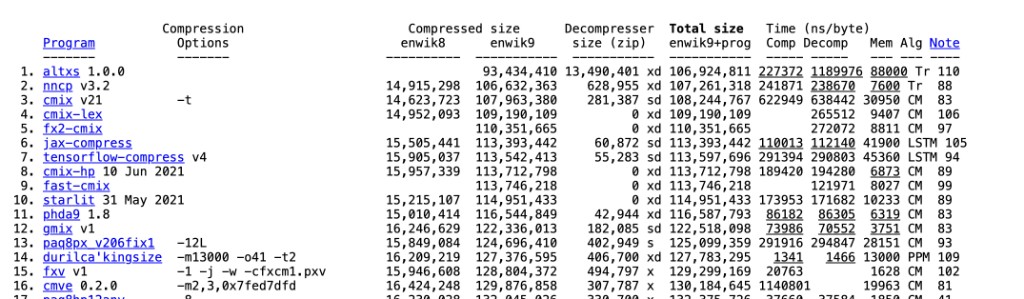
Bars are zero-based and scaled to the largest total on this chart. Official ranking is by total size. Payload is shown for context.
- Public rank
- #1
- Reached
- Aug 30
- Payload
- 93.4 MB
- Total S
- 106.9 MB
We reached #1 on August 30, 2026 with altxs 1.0.0, by official total size — payload plus decompressor. That is the number a partner will check. The board is below.
| System | Corpus | Bytes | Source |
|---|---|---|---|
| Qzip altxs 1.0.0 | enwik9, payload + decompressor | 106,924,811 | ranked #1 August 30, 2026 |
| nncp v3.2 | enwik9, total S | 107,261,318 | LTCB, as of August 30, 2026 |
| Qzip altxs 1.0.0 | enwik9, payload | 93,434,410 | same public row |
Benchmark: Large Text Compression Benchmark (enwik9), lossless, decompressor counted. Program altxs 1.0.0. We reached #1 on August 30, 2026 by official total-size ranking. Payload 93,434,410 + decompressor 13,490,401 = 106,924,811 total. The 91.7 MB figure is a later model, not on the board, and is not the rank.
How each of these numbers is counted · Open the public board
Capacity infrastructure for large cloud users.
The .qzip file is the compressed object. Large clouds use it where data is stored and moved inside infrastructure they already operate.
Cloud capacity
Datasets, checkpoints, archives, and the bytes moving between regions. The same disks and the same links carry more, without a new data center.
Video
The largest volume of bytes in motion. Origin, contribution, and cache fill sit inside infrastructure you control, which is where a .qzip file can be placed.
Encode once. Read it back cheaply.
Cold archives, mezzanine masters, and write-once high-value data fit the engine today: spend the compute at encode, keep every later read inexpensive.
Three ways to spend compute and buy bytes back.
Most compression products give you one setting. We choose the mode from what the asset is worth, because a cold archive read twice a year justifies compute that a live cache never will.
- 01One model, many kinds of dataAmortized across domains
- 02Specialised to a single assetClosest to that file's floor
- 03Search, then verifyHighest value data only
The lead compounds.
A standard is frozen the day it ships. AV1 is frozen. AV2 will be frozen. Ours isn't.
It improves after you buy it
Next year's version beats the one you signed for. No new standard, no hardware swap, no migration.
It specializes
Tuned to each customer's own data, not the compromise a global standard must pick for everyone at once.
The lead is defensible
A competitor cannot fork a moving target. Catching us means catching a system that keeps moving, not out-engineering one release.
The record is the proof. The .qzip file is the product.
- 01Technical moatA public, named result on the field's hardest open benchmark, and an architecture that keeps improving after release — in a field where every standard is frozen the day it ships.
- 02The .qzip fileA portable compressed file designed to capture most of the breakthrough's benefit at a decode cost cheap enough to ship.
- 03Large cloud usersThe accounts already paying to store, move, and power data — and the workloads those clouds carry, starting with video.
- 04Business modelUsage-based infrastructure. Enterprise license plus usage.
Built data and sales where the bytes already hurt.
The people shipping Qzip have built data systems and enterprise sales across OpenAI, 84.51°, Databricks, and Amazon — the rooms where compression, capacity, and a closed deal are the same problem.
- OpenAI
- 84.51°
- Databricks
- Amazon

Conrad Lippert-Zajaczkowski
Founder. Listed author of altxs on the public Large Text Compression Benchmark.

D'Angelo Oberto-Besso Pando
Operations. Keeps the company pointed at shipping, not slides.

Will Simpson
Product. Turns a benchmark engine into something a buyer can place.

Brittany Dao
Enterprise sales. Fortune 500 closes including $33M CVS/Aetna at Adobe.
Hoon
Core build. The binary has to land in a customer's stack, not a lab.
Josh
AI/ML and data quality. The engine is only as honest as the data it is measured on.
Samantha Vidal
Fractional counsel. Commercial and corporate work as the company takes on customers.
The team has closed or supported $180M+ in enterprise revenue. Brittany closed $98M in Fortune 500 deals, including $33M for CVS/Aetna at Adobe.
Measure it on your data.
The fastest way to see whether a .qzip file pays off is to run it on your corpus, against your own tuned baseline.